
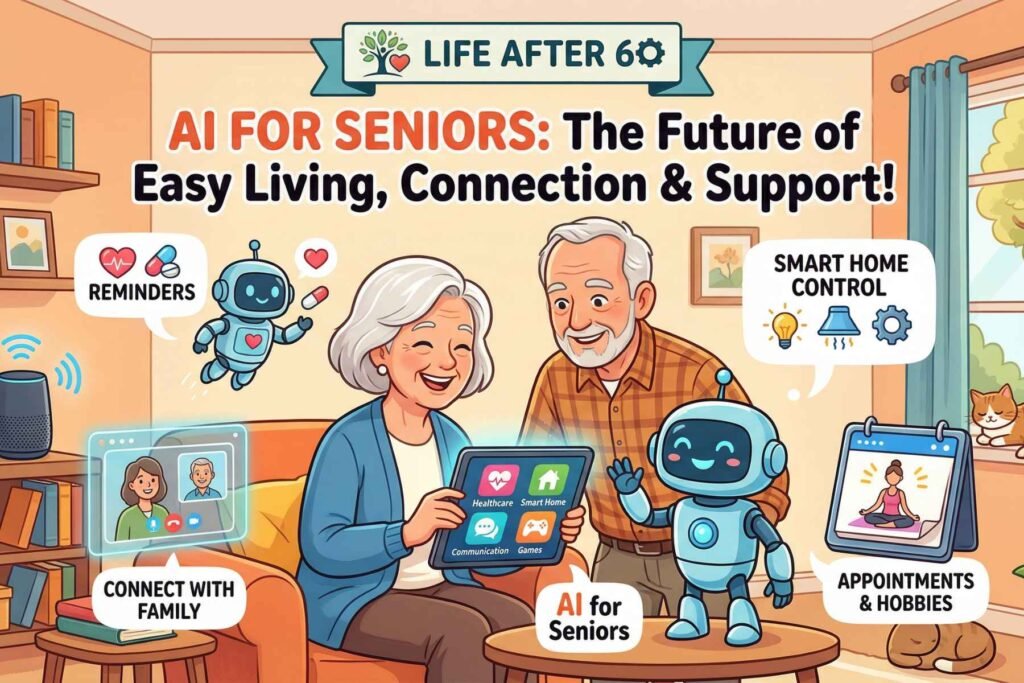
A Senior’s Surprisingly Fun Guide to Artificial Intelligence
Let’s be honest. When most people over 60 first hear the words “Artificial Intelligence,” they picture the Terminator, HAL 9000, or at the very least, something that’s about to steal their TV remote and hold it hostage. But the truth is far less dramatic, and frankly, a lot more useful. AI is here, it’s growing fast, and if you haven’t already stumbled into it, you will soon. So let’s figure this thing out together, with a smile and absolutely no jargon we can’t explain.
So… What Exactly Is AI?
Artificial Intelligence is software, not a robot, not a person, not a tiny man living inside your phone, that has processed enormous amounts of information and learned to respond intelligently. Think of it as a very well-read assistant who has literally read the entire internet and never once complains about it.
You’ve almost certainly already used AI without knowing it. When Amazon says “Customers also bought…”, that’s AI. When your email helpfully suggests “Can’t wait!” as a reply, also AI. When Spotify somehow knows you want to hear Fleetwood Mac at 7pm on a Tuesday, definitely AI (and honestly, a little spooky).
Tools like Siri, Alexa, Google Assistant, and chatbots like Claude or ChatGPT are all forms of AI you can actually have a conversation with. They listen, they respond, and unlike your brother-in-law, they will not argue back.
How Can AI Actually Help Seniors?
This is where things get genuinely exciting. AI might be one of the most useful technologies ever developed for older adults, and here’s why:
- Health help: Paste a confusing doctor’s note into an AI chat and ask it to explain in plain English. Suddenly “myocardial infarction risk stratification” becomes something you can understand over breakfast.
- Medication reminders: AI-powered apps like Medisafe will remind you when to take what, no sticky notes required.
- Beating loneliness: AI assistants will hold a conversation any time of day or night, answer questions, tell jokes, and play trivia. No scheduling, no cancellations, no waiting.
- Writing made easy: Need to reply to an email but don’t know how to phrase it? Describe what you want to say and let AI write the first draft. You can always add your own flair (and a few more exclamation points).
- Voice-first living: For those with limited mobility or vision, voice-activated AI removes a lot of friction from daily life. Just say what you need.
- Learning anything: Always wanted to learn to paint, understand the stock market, or finally figure out what your grandkids are talking about? AI is endlessly patient as a teacher.
How Can AI Hurt Seniors? (Yes, I’m Going There)
No technology guide worth its salt skips the scary stuff. AI has a darker side, and seniors are unfortunately among the most targeted groups. Here’s what to watch for:
- Voice-cloning scams: This is the big one. Criminals can now use AI to clone a family member’s voice and call you pretending to be your grandson in trouble, begging for money. If you get a panicked call from a “family member” asking for cash urgently, hang up and call them directly.
- Confident misinformation: AI can state incorrect things with total, unshakeable confidence. It might give you wrong medical advice or fabricate a “fact.” Always verify health information with your doctor.
- Privacy trade-offs: Many AI apps collect your data. Knowing what you share, and reading at least the highlights of a privacy policy, matters.
- Over-reliance: AI is a tool, not a doctor, lawyer, or financial advisor. Use it to inform yourself, but make important decisions with qualified humans.
PRO TIP: Create a secret family codeword that only real family members would know. If a “family member” calls in a panic and can’t say the word, it’s a scam. Simple, effective, and kind of fun to set up.
Also, I have dedicated an entire section to Scams and Identity theft. Use the link below to check it out and stay one step ahead of the fraudsters.
Pros & Cons at a Glance
The Good Stuff:
- Available 24/7, no hold music, no waiting, no “press 1 for English”
- Infinitely patient, ask the same question as many times as you need
- Reduces isolation and keeps your brain engaged
- Supports independence and aging in place
- Free or low-cost options are widely available
The Not-So-Good Stuff:
- A prime hunting ground for sophisticated scams
- Occasionally wrong, always confident about it
- Real privacy trade-offs with data collection
- Can feel overwhelming at first, but so did the microwave
- No substitute for real human connection or professional care
7 Tips to Get the Most Out of AI
Start here and build from there:
1. Begin with a voice assistant.
Alexa or Google Home are the gentlest starting points. No typing, no passwords, just talk. They’re basically magic lamps with better customer service.
2. Ask follow-up questions freely.
Say “explain that more simply” or “give me an example” without any guilt. AI doesn’t sigh. It doesn’t check its watch. It just answers.
3. Never share personal info unprompted.
A real AI assistant will never ask for your Social Security number, Medicare ID, or bank details. If something does, close it immediately.
4. Use it for medical translation, not diagnosis.
AI is brilliant at helping you understand what your doctor said. It is not your doctor. Always confirm health decisions with a real professional.
5. Turn on accessibility features.
Most AI apps and devices support larger text, high contrast, and enhanced audio. Don’t suffer with the default settings, make it work for your eyes and ears.
6. Try senior-focused tools.
Products like GrandPad and ElliQ are designed specifically for older adults, simplified interfaces, real human support, and no overwhelming notifications.
7. Set that family codeword.
I’ve said it before and I’ll say it again: establish a secret word with close family members. It’s your best defense against voice-cloning scams and takes about three minutes to set up.
Final Thoughts
Here’s the bottom line: AI is one of the most genuinely useful technologies to come along in decades, and in many ways, it was practically made for older adults. It’s patient, available around the clock, doesn’t judge, and can help you stay healthier, more connected, and more independent for longer. Yes, it has risks, but so does driving, and most of us still do that just fine. The key is to approach AI with curiosity, a healthy dose of skepticism, and the understanding that it’s a tool, not a master. Start small, ask questions boldly, guard your personal information like it’s your secret potato salad recipe, and remember: the robot really doesn’t bite. It occasionally gets things spectacularly wrong, it sometimes misses the emotional point entirely, and it will never replace your best friend or your family doctor. But as a helpful, tireless, always-available assistant? It’s pretty hard to beat. Welcome to the future, it’s friendlier than it looks.