
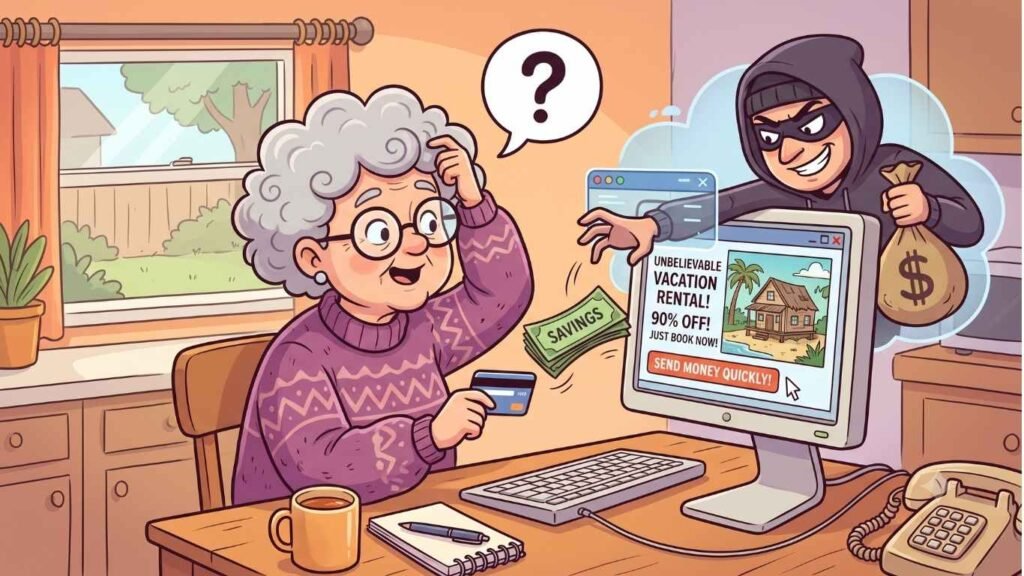
Avoiding Vacation Scams: From Fake Rentals to Bogus Tours
Let’s talk about something almost as exciting as planning a vacation: getting swindled out of your vacation money before you even leave the driveway. Doesn’t quite have the same ring to it, does it?
Here’s the thing about scammers who target travelers, they’ve figured out that a good deal on a beach house is basically catnip for anyone who’s spent the last six months staring at a calendar counting down the days until retirement finally lets them go somewhere. And thanks to AI tools that can now whip up a gorgeous fake hotel website or a picture-perfect rental listing in about the time it takes you to brew a pot of coffee, these scams have gotten a lot more convincing than the “Nigerian prince needs your help” emails of years past. So grab that coffee, get comfortable, and let’s make sure your next trip involves nothing shadier than an overpriced hotel minibar.
What Exactly Are Vacation Scams?
Vacation scams are exactly what they sound like: schemes designed to separate you from your money by dangling the promise of a dream trip in front of you, then either delivering nothing at all or delivering something far worse than advertised. They come in a few flavors, fake rental properties, bogus tour packages, phony “too good to be true” travel deals, and even scams that pop up once you’ve already arrived at your destination.
What makes these particularly nasty is the timing. You’re excited, you’re in planning mode, and you want to believe that beachfront condo really does rent for $400 a week. Scammers count on that excitement to short-circuit the part of your brain that would normally say, “Wait a minute, this seems fishy.”
How These Scams Typically Operate
The Ghost Rental. This is the classic. Scammers post a listing for a gorgeous vacation home, condo, or cabin, complete with beautiful photos. Problem is, the property either doesn’t exist, isn’t actually available, or belongs to someone who has no idea their home is being “rented” to strangers. Often the photos are stolen straight from a legitimate real estate listing or an actual working rental, dressed up with a fake price tag and a scammer’s contact information.
The Duplicate Listing. Similar idea, sneakier execution. A scammer copies a real listing from a trusted platform like Airbnb or Vrbo, then reposts it somewhere else, a classified ad site, a Facebook group, a “too easy to find” website, at a lower price. You book, you pay, and the real host never sees a dime because they never knew any of this was happening.
The Off-Platform Redirect. You find a rental on a reputable site, everything looks legitimate, and then the “host” suggests moving the conversation to text, email, or WhatsApp to “avoid platform fees.” This one sentence is basically a giant neon sign reading “Please Send Money Into The Void,” because once you leave the protection of the platform, you lose every safeguard that platform offers.
The Bogus Tour or Package Deal. These show up as unsolicited emails, pop-up ads, or even phone calls announcing you’ve “won” a free cruise or an unbelievably cheap all-inclusive package. There’s almost always a catch buried in fine print, hidden fees, high-pressure phone calls, or a requirement to hand over a credit card number just to “hold your spot.”
The Urgency Trap. Whether it’s a fake rental or a fake tour, scammers love manufactured urgency. “Only one unit left!” “Fifteen people are viewing this property right now!” “This price expires in one hour!” It’s the digital version of a used car salesman refusing to let you sleep on a decision, and it works because it doesn’t give your good sense time to catch up.
How to Recognize a Vacation Scam
Here’s your cheat sheet for spotting trouble before you hand over your credit card:
- The price feels too good to be true. A beachfront property for a fraction of what everything nearby is charging isn’t a steal, it’s bait.
- The host wants to take things off the platform. Any request to email, text, or call you directly instead of using the site’s built-in messaging should raise an eyebrow.
- Payment requests are unusual. Wire transfers, gift cards, cryptocurrency, or apps like Zelle and Venmo offer little to no protection if things go sideways. Legitimate booking sites use secure payment systems for a reason.
- The listing has no reviews, or oddly generic ones. A property with zero history or a suspicious pile of vague five-star reviews posted within days of each other is worth a second look.
- You can’t find independent confirmation. Search the property address or the exact wording of the listing online. If the same photos and description show up elsewhere at a different price or under a different host name, walk away.
- They pressure you to decide right now. Real vacation deals will still be there tomorrow. Manufactured urgency is a classic scam tactic, not a genuine limited-time offer.
- Something about the website feels slightly off. A URL that’s almost right but not quite (think “Airbnb-rentals-direct.com” instead of the real thing) is a common trick. Scammers can now build a fake site that looks nearly identical to a legitimate one, padlock icon and all, so don’t assume a professional-looking page means a legitimate one.
What to Do If You Think You’re Being Scammed
If your gut is telling you something’s not right, trust it, your gut has gotten you this far in life, it knows what it’s talking about.
- Stop the conversation and don’t send any more money. If you’ve already paid a deposit, don’t send the “remaining balance” no matter how convincingly they ask.
- Verify independently. Call the property management company directly using a phone number you find on your own (not one the “host” gave you), or search the address to see if it turns up in an actual real estate listing.
- Contact your bank or credit card company. If you paid by credit card, you may be able to dispute the charge. This is one of many good reasons to always use a credit card for travel bookings rather than a debit card, wire transfer, or gift card.
- Report it. Report suspicious listings to the platform they appeared on, and consider filing a report with the FTC at ReportFraud.ftc.gov or the FBI’s Internet Crime Complaint Center at ic3.gov.
What to Do If You’ve Already Fallen for One
First things first: take a breath. Scammers are professionals at this, and falling for a well-crafted scam doesn’t mean you did anything foolish, it means you ran into someone whose full-time job is deception. Beating yourself up over it won’t get your money back, so let’s focus on what will.
- Contact your bank or credit card issuer immediately to report the fraudulent charge and ask about a chargeback or dispute.
- Change your passwords for any accounts you may have used during the transaction, especially if you shared login information or clicked a suspicious link.
- Report the scam to the platform where you found the listing, as well as the FTC and IC3 mentioned above. Your report could help someone else avoid the same trap.
- Document everything. Save screenshots of the listing, your payment confirmation, and any messages exchanged. This will help both your bank’s investigation and any official reports.
- Consider a credit freeze if you shared sensitive personal information, just to be safe.
- Talk about it. Tell a friend, a family member, or heck, leave a comment on this very post. The more we talk about these scams openly, the harder it is for scammers to keep pulling them off.
Final Thoughts
Vacation scams thrive on excitement, urgency, and the very human hope that yes, this really could be that perfect little getaway at that perfect little price. There’s nothing wrong with hoping for a great deal, just make sure you’re pairing that hope with a healthy dose of skepticism and a few good verification habits. Book through reputable platforms, keep your payments on the record, take your time even when someone’s telling you not to, and trust that little voice in your head when it starts whispering “this seems off.” Do that, and the only thing you’ll need to worry about on your next trip is whether you packed enough sunscreen. Safe travels, my friends.