
Because “I’ve fallen and I can’t get up” should stay a TV commercial, not your Tuesday morning.
A Room-by-Room Reality Check
You’ve worked hard for decades, survived a thousand Monday mornings, and finally made it to the finish line, retirement. You have big plans: sleeping in, traveling, spoiling grandkids, and never sitting through another pointless staff meeting. But before you crack open that celebratory bottle of wine, there’s one question worth asking: Is your home actually ready for you to grow old in it?
Whether you live in a sprawling ranch house, a cozy condo on the third floor, a sun-drenched townhouse, a mobile home, or even a well-appointed RV parked in a Florida campground (hello, neighbors!), the principles of retirement-ready living apply everywhere. And the good news? Most of the changes are surprisingly affordable, genuinely manageable, and occasionally hilarious to explain to your adult children.
Let’s take a tour.
Why Home Safety in Retirement Actually Matters
Here’s an uncomfortable truth served with a side of humor: our bodies, like our cars, require more maintenance as the miles pile up. Vision softens. Balance gets a little… creative. Joints that once bent enthusiastically now offer unsolicited opinions. None of this means life gets less wonderful, it just means the home environment that worked perfectly at 40 might need a few upgrades at 65.
According to the CDC, falls are the leading cause of injury among older adults, and the majority of them happen at home. The good news is that most falls, and many other home hazards, are entirely preventable with a few smart adjustments. Think of it less as “making your home old-person-friendly” and more as “making your home so smart it practically takes care of you.”
The Bathroom: Your Home’s Most Treacherous Room
Let’s start where the statistics are most alarming and the humor is most necessary: the bathroom.
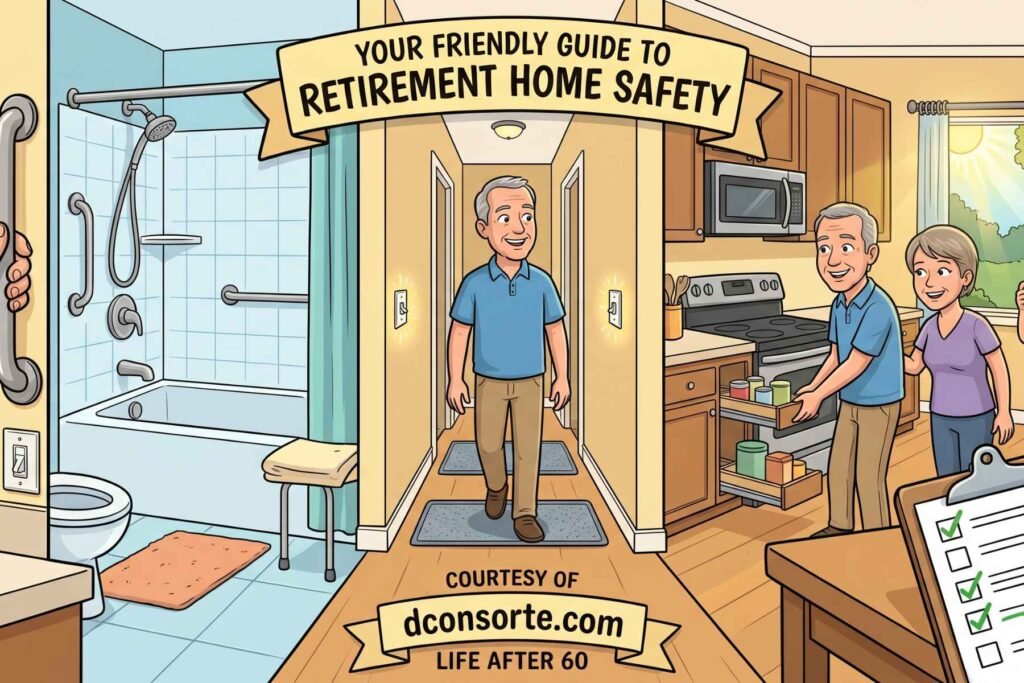
The combination of wet floors, slippery tubs, and the physical gymnastics required to lower yourself onto a standard toilet makes the bathroom a genuine obstacle course. The fix? Grab bars, and not the kind that look like they were salvaged from a hospital. Modern grab bars come in brushed nickel, matte black, and styles that look intentionally decorative. Install them in the shower, beside the tub, and next to the toilet.
While you’re in there:
- Add a non-slip mat or textured strips to the shower floor and bath area.
- Consider a walk-in shower if a remodel is in your future, stepping over a tub ledge is a genuinely risky move.
- A raised toilet seat or comfort-height toilet reduces the “lowering into the abyss” experience considerably.
- Install a handheld showerhead so bathing doesn’t require circus-level balance.
- Make sure the water heater is set to 120°F or below to prevent scalding, reaction times slow as we age.
The Kitchen: Convenience Over Acrobatics
Nobody should have to climb a step stool to retrieve the good china at age 72. The kitchen is all about accessibility and convenience.
- Move frequently used items to lower, easy-to-reach cabinets.
- Install pull-out shelves and lazy Susans to eliminate the full-body lean into the back of a cabinet.
- If the kitchen is due for an update, look into lever-style faucet handles, they’re far easier on arthritic hands than twist knobs.
- Make sure your stove knobs are clearly labeled and easy to operate. Smooth cooktops eliminate the tripping hazard of raised gas burners.
- Keep a fire extinguisher handy and a working smoke detector nearby. Also, if you haven’t tested your smoke detectors since the Clinton administration, now is the time.
Floors, Stairs & Entryways: The Hazard Highway
Floors are sneaky. Rugs bunch up. Thresholds catch toes. Stairs become a cardiovascular event. Here’s how to navigate the hazard highway:
- Remove or secure all throw rugs, they are adorable trip hazards in disguise. Either anchor them with non-slip backing or bid them farewell entirely.
- Install handrails on both sides of every staircase, and make sure they’re sturdy enough to actually support weight.
- Consider stair lighting, motion-activated LED strip lighting along stair edges is inexpensive and potentially life-saving.
- Widen doorways if mobility aids like walkers or wheelchairs are a possibility, 36 inches is the gold standard.
- Ensure entryways are well-lit and level. If there’s a step at the front door, a small ramp or grab bar near the entry is a worthwhile addition.
- Declutter hallways and pathways ruthlessly. The floor is not storage.
Lighting: Your Whole House Needs to See Better
Here’s a simple fact: after age 60, your eyes need roughly three times more light than they did at 20 to see the same detail. Your home probably isn’t keeping up.
- Replace all standard bulbs with bright LED bulbs, they’re efficient, long-lasting, and dramatically improve visibility.
- Add night lights in hallways, bathrooms, and the kitchen for those middle-of-the-night excursions.
- Install motion-activated lights at exterior doors, in garages, and on staircases.
- Make sure light switches are easy to find in the dark, consider illuminated switch plates.
Bedroom: Rest Easy (Safely)
The bedroom should be your sanctuary, not a minefield.
- Your bed height matters, if you need a running start to climb in, it’s too high. If getting out requires a controlled descent, it’s too low. Aim for a height where your feet rest flat on the floor when seated on the edge.
- Keep a lamp or light switch within arm’s reach of the bed so you’re never stumbling in the dark.
- If a medical alert device makes sense for your situation, a bedside option offers peace of mind for you and everyone who loves you. Check out my post on Medical Devices.
- Keep a phone charger at the bedside, because 3 a.m. is not the time to go hunting.
Technology: Let Your Home Work for You
Here’s where retirement-ready living gets genuinely exciting. Smart home technology has made aging in place more manageable than ever before.
- Smart doorbells and locks mean you can see and communicate with visitors without navigating to the door.
- Voice-activated assistants (Alexa, Google Home) can control lights, thermostats, and entertainment with zero physical effort.
- Medical alert systems have evolved well beyond the old-fashioned necklace, modern versions are stylish, discreet, and detect falls automatically.
- Video monitoring can give family members peace of mind without turning your home into a surveillance state.
Special Considerations by Home Type
Apartment/Condo: Talk to your building manager about grab bar installation (most will allow it with the right hardware). Confirm that elevators are functional and have a backup plan if they’re not. Know your building’s emergency exit plan.
Townhouse: Multi-level living means stairs every day. Consider whether the main essentials, bedroom, full bath, kitchen, can all be on one floor if needed.
Mobile Home: Check flooring stability regularly, as soft spots can develop over time. Ensure steps at the entry are solid and handrails are secure.
RV: Know your campground’s emergency resources. Keep a well-stocked first aid kit. Make sure entry steps have secure handrails and are well-lit.
Final Thoughts
Making your home retirement-ready isn’t about admitting defeat to the calendar, it’s about playing offense. Every grab bar, every removed throw rug, every bright new LED bulb is an act of self-preservation and, honestly, self-respect. You’ve earned the right to live comfortably, independently, and safely in whatever space you call home, for as long as you choose. That doesn’t happen by accident; it happens because you were smart enough to think ahead.
The beautiful irony is that most of these changes don’t just make your home safer for you, they make it better for everyone. Better lighting? Everyone benefits. Cleared pathways? Your guests will thank you. Lever-style door handles? Anyone carrying grocery bags has silently wished for these their entire life. Retirement-ready design is just good design.
So take the checklist, do the walkthrough, call the handyman (or the handy adult child), and make your home the safe, comfortable haven it was always meant to be. You’ve got a lot of good living left to do in it, make sure your home is ready to keep up with you.
I have put together a handy checklist called the “Home Safety Checklist” available to you for free. Click the button below for your free (Seriously, free. You don’t need to enter any information to get it) download.