
Medical Disclaimer: This blog post is intended for informational and entertainment purposes only and does not constitute medical advice. Always consult your physician or a qualified healthcare provider before beginning any new exercise program, especially if you have a history of falls, dizziness, joint problems, or any chronic health condition. If you feel pain, dizziness, or discomfort at any time during these exercises, stop immediately and seek medical guidance.
Balance Exercises for Seniors: Tone Your Body Without Missing Your Favorite Shows
Let’s be honest, nobody wants to feel like a wobbly shopping cart every time they reach for the top shelf. Yet as we age, balance has a sneaky way of becoming the one fitness category we forget about entirely, right up until the moment the floor suddenly seems much closer than expected.
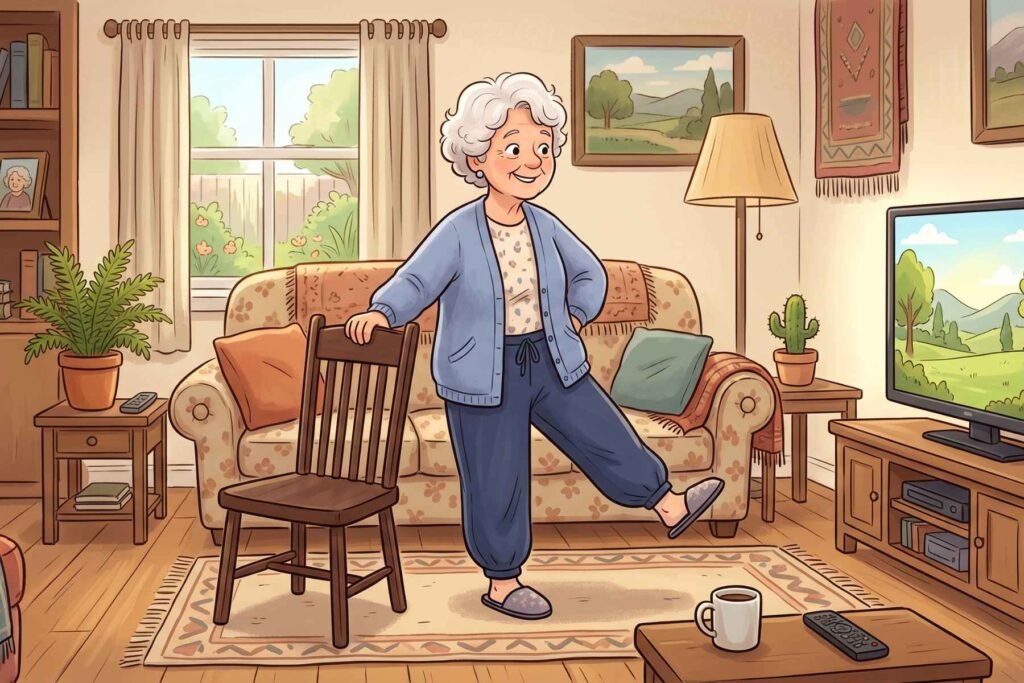
Here’s the good news: you don’t need a gym membership, a personal trainer, or even a commercial break’s worth of motivation to dramatically improve your balance. You just need your living room, a sturdy chair, and whatever’s on TV. Whether you’re binge-watching a mystery series, catching up on the evening news, or trying to figure out what on earth is happening on that reality show your grandkids can’t stop talking about, your TV time can quietly double as your workout time.
Why Does This Matter?
Why does this matter after 60? Because balance is essentially the body’s Wi-Fi signal. When it’s strong, everything runs smoothly, you move confidently, react quickly, and navigate the world without a second thought. When it weakens, daily life gets glitchy. Carrying groceries, stepping off a curb, getting up from a chair, suddenly these feel like minor Olympic events.
The advantage of exercising during TV time is simple: you’re already standing (or at least, you can be). The TV gives you something to focus on, the time passes faster, and before you know it, you’ve done 20 minutes of balance work and your favorite character has solved the murder. Win-win. It also gives you something to do during the millions of commercials that are longer then the show itself.
One important safety note before I dive in: Always have a sturdy chair, wall, or countertop within arm’s reach. These exercises are meant to challenge your balance gently, not to introduce you to your floor.
Why Balance Matters as We Age
After 60, the body starts sending some memos you didn’t exactly ask for. Muscle strength and coordination gradually decline, not dramatically, not all at once, but enough to make a difference over time. The tiny stabilizing muscles in your feet, ankles, and core that quietly do all the behind-the-scenes work start needing more conscious attention.
The result? Falls become the number one cause of injury among older adults. And it’s not just the physical toll, the fear of falling is its own problem, causing many seniors to move less, which weakens balance further. It’s a frustrating loop, but here’s the thing: it’s a loop you can interrupt.
Regular balance practice delivers benefits that ripple outward into everyday life:
- Better stability: Your body becomes more adept at micro-adjustments that keep you upright, whether you’re on a slippery sidewalk or a thick rug.
- Improved confidence: There is nothing quite like the quiet pride of walking across an uneven parking lot without breaking a sweat.
- Greater independence: Better balance means doing more things on your own terms, for longer, without relying on others for help.
Think of balance training as investing in your future self, the version of you who still insists on climbing the ladder to hang the holiday lights at 78.
Before You Begin
A few quick setup tips to make sure your TV workout is safe, effective, and doesn’t result in an unplanned furniture rearrangement:
- Footwear matters. Wear supportive shoes with good grip, or go barefoot on a non-slip surface like carpet or a yoga mat. Socks on hardwood = the enemy.
- Tidy up your space. Clear away any pets, throw rugs, power cords, or grandchildren that might be lurking near your feet.
- Start slowly. If an exercise feels too easy, great, you’ll progress. If it feels too hard, use more support. There’s zero shame in keeping one hand on the chair back for the first few weeks.
- Listen to your body. If you feel dizzy, lightheaded, or unsteady, stop immediately and sit down. These exercises should feel like a gentle challenge, not a carnival ride.
The Exercises: Get Moving During the Show
1. The Commercial Break Calf Raise
Best during: any commercial break, opening credits, or slow plot development
Stand behind your chair with both hands lightly resting on the back. Slowly rise up onto your tiptoes, hold for 2-3 seconds, then lower back down. That’s it. Do 10-15 reps. As you get stronger, try holding the chair with just one finger, or going hands-free for a second if you’re feeling bold. This strengthens the calves and ankles, two of your most important balance muscles.
2. The Single-Leg Stand
Best during: the parts of the show where everyone is just talking
Stand beside your chair and hold the back with one hand. Lift one foot a few inches off the floor and hold for 10-30 seconds. Switch sides. That’s the whole exercise. Simple, effective, and the perfect thing to do while someone on screen is dramatically explaining their feelings for four minutes straight. Work up to doing this without holding the chair as your balance improves.
3. The Heel-to-Toe Walk (Tightrope Walk)
Best during: any scene with a lot of dramatic background music
Clear a few feet of space. Pretend there’s a line on the floor (or use the edge of your carpet as a guide). Walk forward placing the heel of one foot directly in front of the toes of the other with each step, like a sobriety test, but entirely voluntary. Take 10-15 steps forward, then turn and come back. Keep your arms out to the side for extra stability. This is one of the best exercises for improving dynamic balance and coordination.
4. Side Leg Lifts
Best during: the opening 10 minutes of any episode
Stand behind your chair with both hands on the back. Slowly lift one leg out to the side, keeping your body upright and your foot flexed. Hold for a moment, then lower. Do 10-12 reps on each side. This strengthens your hip abductors, the muscles that keep you from swaying side to side when you walk.
5. Seated Marching
Best during: the scenes you’ve accidentally already watched twice
Sit up tall in your chair, no slouching against the back. Lift one knee up toward your chest, lower it, then lift the other. March in place for 30-60 seconds. This might feel like the least impressive exercise on the list, but seated marching improves hip flexor strength and core engagement, both of which are foundational to good balance.
6. Weight Shifting
Best during: literally any scene
Stand behind your chair, feet hip-width apart, hands lightly on the back. Slowly shift your weight onto your right foot, hold for a few seconds, then shift to the left. Continue back and forth for 30-60 seconds. This trains the stabilizing muscles in your ankles and feet to respond to shifts in your center of gravity, exactly what they need to do when you step off a curb or reach across a counter.
7. Standing Hip Circles
Best during: end credits you’re not watching anyway
Stand behind the chair, holding the back with both hands. Slowly rotate your hips in a big circle, like you’re using a very calm, senior-appropriate hula hoop. Do 5 circles in each direction. This improves hip mobility and core control, both of which contribute to better overall balance and a more fluid walking gait.
A Final Word (From Someone Who Wants You Vertical)
Balance training doesn’t have to feel like a big production. It doesn’t require special equipment, a class, or even a significant time commitment. It just requires a little consistency and the willingness to stand up during the slow parts of whatever you’re watching.
Start with two or three of these exercises a few times a week. Notice how your body feels after a month. You might be surprised, a little wobbly shopping cart can become surprisingly steady with some regular attention.
Your future self, the one still climbing that ladder at 78, is counting on you.